CS2 Anti-Cheat Hole Patched: What We Know About VACnet
Valve admitted in patch notes that a bug let cheaters avoid VACnet. What was fixed, how many accounts actually get banned, and what happens to their skins.
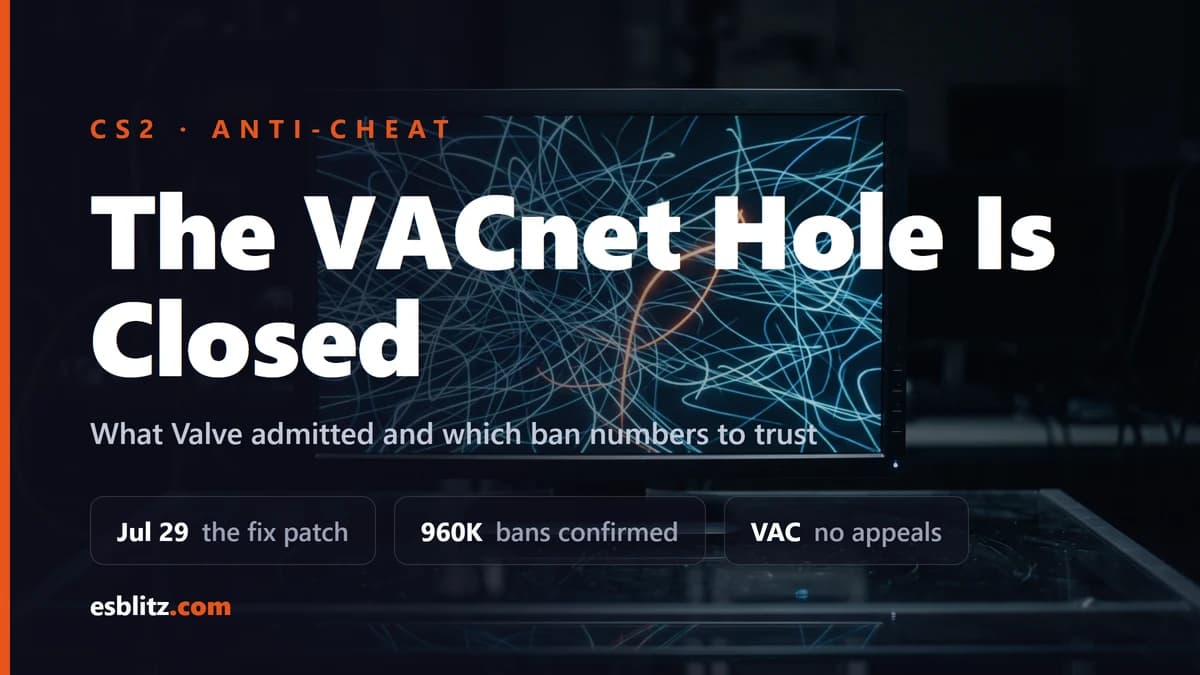
On July 29 Valve shipped a CS2 update with a single line that matters more to the anti-cheat conversation than everything else in the patch: "Fixed a bug that allowed malicious players to avoid being processed by VACnet." A company that normally says nothing at all about its anti-cheat publicly acknowledged a bypass. Let's unpack what changed, and which numbers floating around bans are actually reliable.
What exactly got fixed
Valve's wording is deliberately thin: a bug let some players skip VACnet processing entirely, meaning the system that hunts cheaters by how they play simply never saw them. No timeline, no technical detail.
The community has at least two competing theories about the mechanism, from spoofed aim data to a re-entry loophole. Neither is confirmed by Valve, and we won't dress guesses up as facts: one line of patch notes doesn't distinguish between them. What is verifiable: after the patch, reports of instant bans for blatant rage-cheating spiked, and ban notifications began naming VACnet as the source.
How many accounts actually get banned
This is where invented numbers thrive. Valve doesn't publish ban statistics at all, so nearly everything circulating in the news comes from third-party trackers that index only a slice of Steam.
| Date | Reported | How reliable |
|---|---|---|
| March 27, 2026 | 960,000 farming bot accounts in one day | Confirmed by Valve: CS2 project lead Ido Magal said so himself |
| August 6, 2026 | ~30,000 accounts, inventories worth about $69,000 | One third-party tracker; its own pages disagree on the figures |
| July 25–26, 2026 | ~38,800 accounts | Same tracker, no word from Valve |
"Yesterday we banned 960,000 farming bot accounts. This was the result of a bunch of investigation that benefited from user reports." Ido Magal, CS2 project lead, said that in March 2026.
The direction is clear enough: the waves target farming operations, clusters of dozens of accounts grinding matches for weekly drops, lately especially in Wingman. As for the August wave, it may well have happened, but we're not going to print unverified third-party numbers as fact. We treated Valve's other summer decisions with the same caution. See our takes on the Major sticker reissue and the map pool shake-up.
How VACnet works
Classic VAC looks for banned software on your machine. VACnet works differently: it watches how a person plays (aim trajectories, shot timings, view angles) and scores the likelihood that no human moves like that. The system was presented back at GDC 2018: a neural network trained on manual review verdicts, and ban accuracy jumped dramatically once machine learning came in.
There's a real-time layer too: at high confidence the match is stopped mid-game, the cheater is removed, and nobody else loses rating. The term "VACnet 3.0" you'll see in articles isn't Valve's: it's tracker-and-blog shorthand.
What happens to a banned account's inventory
The common myth is that skins burn. They don't: items stay on the account but get a trade ban. They can't be sold, traded or listed on the Community Market: the inventory becomes a display case its owner can no longer monetize. So read "$69,000 frozen" for what it is: the value of locked items, not confiscated ones.
You can check what your own inventory is worth (and what actually lands in your pocket when selling) in our skin payout calculator, and where it's safest to sell in our marketplace guide.
What if a legitimate player gets banned
It happens, and recently. In January 2026, after an update, some players caught VAC bans because sharp mouse movements at high DPI read as a spin-bot to the system. A professional player was among them. Valve acknowledged the error in patch notes and reversed every wrongful ban.
That's the rare exception: a standard VAC ban can't be appealed through support, which has no tooling to lift one. Bans get reversed only in bulk, when Valve itself finds the flaw in its detection.
Frequently Asked Questions
What did Valve fix in CS2 anti-cheat on July 29, 2026?
Per the official patch notes, a bug that allowed malicious players to avoid being processed by VACnet. Valve disclosed neither the technical details nor how long the bug existed, and community theories about the mechanism remain unconfirmed.
How many accounts has Valve banned in CS2 in 2026?
The only officially confirmed figure is 960,000 farming bot accounts on March 27, 2026, stated by the CS2 project lead. Summer wave numbers come from third-party trackers and have never been confirmed by Valve.
What happens to skins after a VAC ban?
Items aren't deleted, but the account receives a trade ban: selling, trading or listing skins on the Community Market becomes impossible. In practice the inventory is frozen along with the account.
Can a VAC ban be appealed?
Not through Steam Support: it has no technical means to lift a VAC ban. The exception is when Valve discovers a detection error itself and reverses bans in bulk, as it did in January 2026 after false positives on high-DPI mouse movement.
Related and newer: in September 2026 an exploit with a fake VAC ban appeared on the Valve bug tracker, cancelling losing matches.
Sources
Valve described the fix in a single line of the patch notes of July 29, 2026: a bug that let malicious players avoid being processed by VACnet was fixed. How ban waves work and why they stay invisible for weeks is covered in where the VAC bans went.
Big CS2 news, first on our Telegram
Patches, tournaments, pro settings. No fluff.