The Major Sticker Crisis: $600k to $120k in a Single Tournament
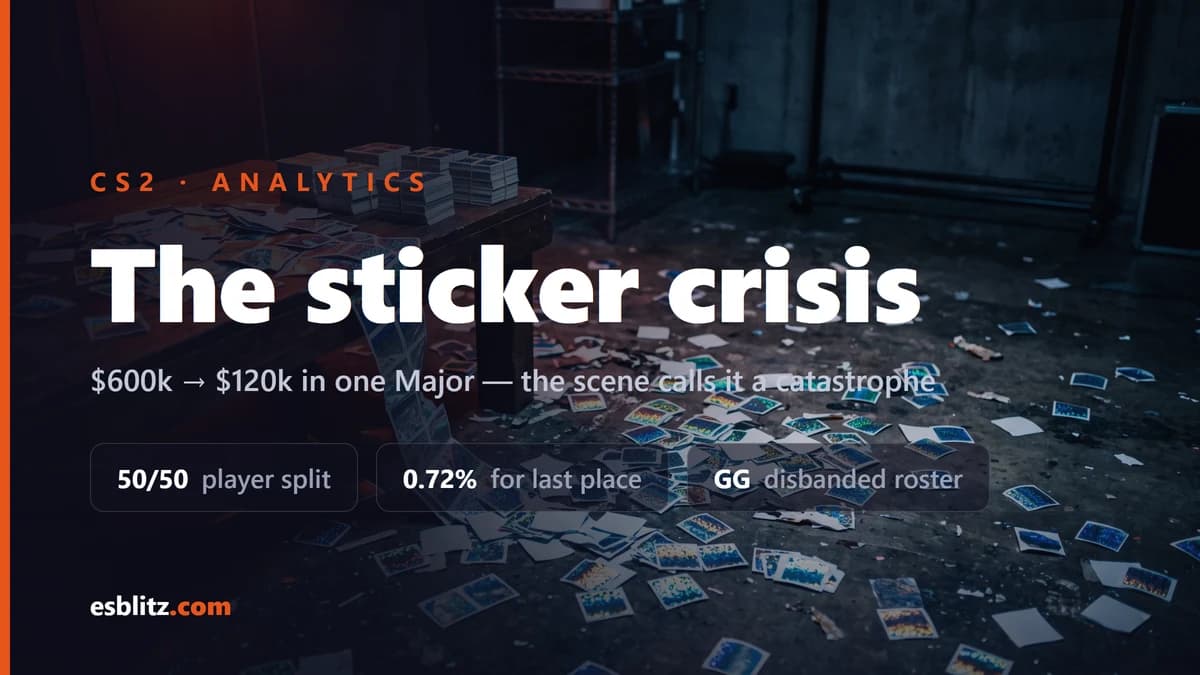
The Token Shop killed capsules, and Major sticker revenue collapsed from $600k to $120k. Who calls it a catastrophe and why tier-2 orgs are hit hardest.
HLTV has published a deep dive into the fallout of the new Major sticker system, and the numbers are darker than the most pessimistic forecasts. A Stage 1 team at IEM Cologne Major 2026 earned around $120,000 from stickers, against roughly $600,000 for a team at the same stage of the Budapest Major just half a year earlier. An anonymous org representative put it bluntly: "This is a catastrophe for the CS scene."
What Valve changed
Cologne was the first Major without the familiar capsules: instead of a loot box with a random sticker, the Token Shop with direct purchases and dynamic pricing. We broke down how the store works back in June in our Token Shop and Cologne 2026 pricing explainer. Even then a full set cost $19,447, and the questions were obvious.
But the real blow isn't the prices. It's the revenue split. Under the new scheme teams receive 50% of store and pass revenue: 5% goes to the tournament organizer, and 45% is divided between all 32 participants based on Valve's regional standings and results. Within each team a mandatory 50/50 split with the players applies. Organizations used to negotiate that share themselves. Now Valve dictates it. The result: out of $120,000 in "team" money, the organization itself keeps about $60,000.
The numbers
| Metric | Budapest 2025 (capsules) | Cologne 2026 (Token Shop) |
|---|---|---|
| Stage 1 team revenue | ~$600,000 | ~$120,000 |
| Of which: the organization | negotiated with players | ~$60,000 (mandatory 50/50 split) |
| Sales a month after the event | capsules sold for months | ~$100 a day |
The new distribution formula stings too: the team finishing last receives just 0.72% of the total pool. For perspective: Paris Major 2023 sticker sales brought the scene over $110 million combined, and even being the Major's biggest underdog was a financially enviable spot.
Voices from the scene
SINNERS co-founder Moritz "Askadar" Straube says he saw it instantly: "From the first moment, I knew this was going to be a disaster." His organization invested $25,000–35,000 in flights and bootcamps in Q1, expecting the Major to pay it back, under the old math that had held for nearly a decade.
Aurora founder Valeriy "L3rich" Kharitonov called Cologne "the worst major in terms of sticker sales by a huge margin" back in early June. 100 Thieves Head of Operations Graham "messioso" Pitt predicts outright wild scenarios: "In some cases, I think you're going to find teams going to players asking them to pay back the money that Valve has sent them." And UNCORE co-CEO Daniel "Vorborg" Vorborg points to the systemic risk: the rules were changed once without warning, meaning they can change again, and contracts written for the old model now hang in the air.
The first casualty is already here
Gaimin Gladiators disbanded their CS2 roster within days of Cologne, officially citing "recent changes to the Major ecosystem and revenue structure." The team went out 0-3 and received those very 0.72% of the pool under the new formula. For tier-2 organizations, where stickers were the main argument for keeping a CS division alive, the precedent is alarming. We covered the fragility of that segment in our Johnny Speeds benching breakdown.
What comes next
Valve's official position: direct purchases are more convenient than randomness, and loot-box capsules are unavailable in several regions. Not a word about the money. The HLTV piece relays the scene's counter-proposals: fixed sticker prices instead of dynamic ones, or trading-card-style packs (a guaranteed rare sticker for a straightforward $10). The overall mood among HLTV's sources is skeptical: few believe the system will be fixed before the PGL Singapore Major in late November.
The irony is that players themselves partly won: the mandatory 50/50 split locked in a share they previously had to negotiate for. You can see how that works in practice in the recent karrigan trophy and kyxsan stickers story: the sticker royalties stayed with the registered player. The losers of the new system are the organizations. And if Valve doesn't rebalance before Singapore, the count of disbanded rosters may grow. We track the scene's economics in our news section.
Big CS2 news, first on our Telegram
Patches, tournaments, pro settings. No fluff.