Valorant Ranks: RR, Acts and Premier Guide
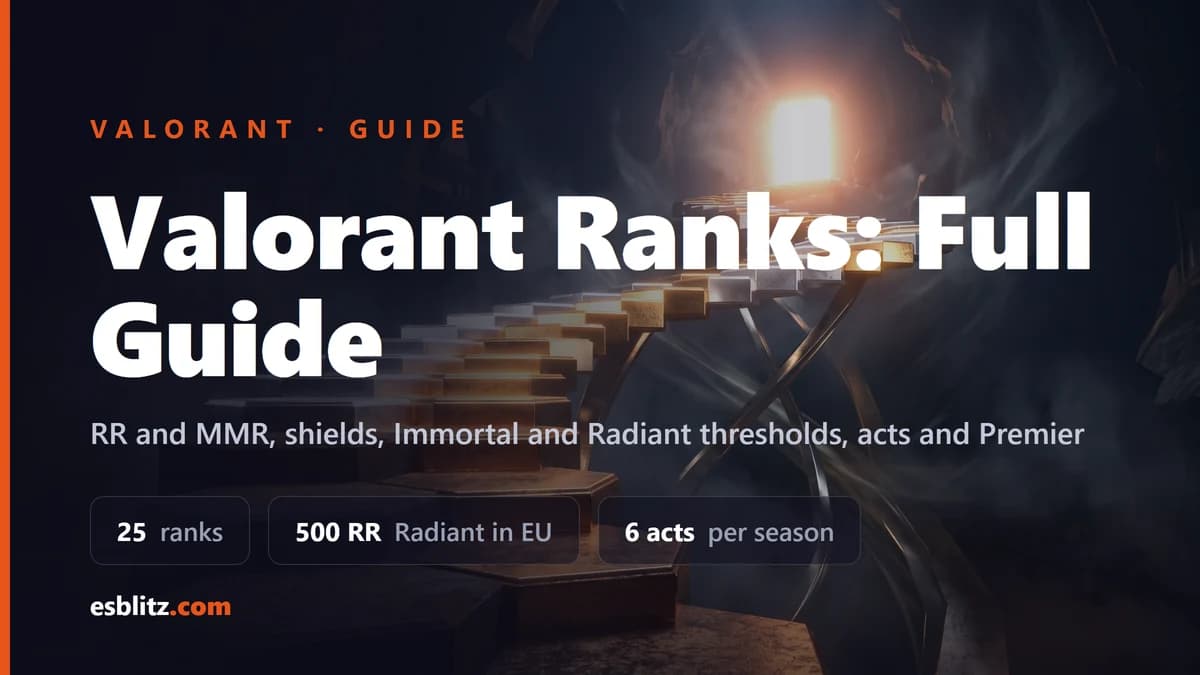
All 25 Valorant ranks in order, RR and hidden MMR, Immortal and Radiant thresholds by region, where you really stand among players, and Premier in 2026.
Valorant's ranked system is fairer than it feels after a losing streak: the visible rank is a shop window, while the hidden MMR decides, and the rank is constantly pulled towards it. That is where the eternal questions come from, "why +14 for a win and −22 for a loss", "how many placements after a new act", "what does Radiant take in Europe". Below is a full breakdown of the 2026 system from Riot's official materials: ranks, Rank Rating, shields, six-act seasons, party restrictions and Premier for anyone who wants to play as a team.
All Valorant ranks in order
Nine ranks, each except Radiant with three tiers, 25 positions in total:
| Rank | Tiers | How you climb |
|---|---|---|
| Iron | 1–3 | 100 RR per tier; after a promotion you start with at least 10 RR |
| Bronze | 1–3 | |
| Silver | 1–3 | |
| Gold | 1–3 | |
| Platinum | 1–3 | |
| Diamond | 1–3 | |
| Ascendant | 1–3 | |
| Immortal | 1–3 | RR accumulates with no cap, tiers follow regional thresholds |
| Radiant | — | Regional RR threshold + top 500 of the region |
Ascendant arrived in patch 5.0 (June 2022) between Diamond and Immortal to decongest the top of the ladder. Competitive unlocks at account level 20: the rule has applied since Episode 4 Act 1; the old "10 Unrated wins" requirement is gone.
Where you actually stand
The question behind every rank check is simple: is Gold a lot or not? The answer below is vaguer than the tables you will find elsewhere, and that is deliberate: those tables look far more precise than the data behind them.
Riot has published real distribution numbers exactly once, back in August 2021, and never updated them. Everything you see for 2026 comes from third-party trackers that read the public Riot API. Those trackers only see players someone looked up, not the whole population, and their numbers disagree with each other: pulling the same month from the same site twice can move Bronze by five percentage points. So treat any table down to hundredths as decoration.
What the trackers do agree on is the shape:
- Silver and Gold are the crowd. Each holds roughly a fifth of the player base, and together with Bronze they cover the bulk of everyone playing ranked.
- Iron through Silver is about half the ladder. Reaching Gold already puts you above the median player, which surprises most people who feel stuck there.
- Ascendant is a wall. Only a small single-digit share of players ever gets past Diamond into it.
- Immortal and above is around one percent. Radiant is smaller still: it is capped at the top 500 of each region by design, not by RR alone.
If you want a number for your own region on a given day, open a tracker and read it there: it will be fresher than any article, this one included.
How to check your rank outside the game
Riot has no official web page that shows your rank, unlike League of Legends. In game it sits in the Career tab. Outside, the usual route is a tracker: look yourself up by Riot ID in the Name#Tag format on tracker.gg, op.gg or blitz.gg. They pull from the public Riot API and never ask for your password, so a lookup cannot touch the account itself.
A tracker only starts recording your matches once someone has looked up your profile. If your history there begins abruptly, that is why, not a bug.
Placements and six-act seasons
Since 2025 Riot has dropped Episodes: a year is a season (V25, V26) split into six acts. Act 1 and Act 4 bring a full reset, 5 placement matches, with Ascendant as the highest starting rank. That last part is literal: an Immortal or Radiant player does land back in Ascendant after placements, however the five games go, and climbs the last stretch again. In the other acts one match is enough: your rank does not drop automatically, but a rough placement can lower it. After placement you start at 50 RR.
The current act is V26 Act 5, which began with patch 13.04 (18 August 2026); Act 6 will close the season at the end of the year. The map pool changed with the act too: Abyss is back, Breeze is out, details in our patch 13.04 breakdown. For Immortal and Radiant the mid-season acts are harsher: one placement game, RR cut by 90%, and every Radiant returns to Immortal, the leaderboard position is kept.
Act Rank is a separate career badge: a triangle filled by wins that shows your best win of the act ("proven skill"), not your current rank.
How RR is calculated
Riot lists four factors, in descending weight:
- Match outcome. A win gives base RR, a loss takes it away. You cannot gain RR from a loss.
- Round differential. 13:2 gives more than 13:9; 3:13 takes more than 11:13.
- Individual performance: damage and assists, not just kills. Slightly boosts gains or cushions losses; in Immortal and Radiant this factor barely applies, only the result counts there.
- Rank convergence to MMR. MMR is a hidden ladder where no two players share a spot. If MMR is above your rank, wins pay more and losses cost less; if below, the reverse.
That answers the eternal "I win +14 and lose −22": the rank has run ahead of the MMR and the system is pulling it back. The only cure is consistent wins and above-average stats for your lobby. The opposite case is a double promotion: with MMR far above the rank the system skips a tier, for example straight from Gold 1 to Gold 3.
Shields and demotion
To drop a tier you need to reach 0 RR and lose again; after a demotion you get at least 70 RR. Between ranks, Rank Shields apply: entering the first tier of any rank (Silver 1, Gold 1 and so on) grants two shields. A loss at 0 RR consumes a shield instead of demoting; a third straight loss at zero drops you to the previous rank. Shields do not protect between tiers of the same rank (Silver 2 → Silver 1) and refresh only when you enter a first tier again. Dodges and remakes do not consume a shield.
Immortal and Radiant: thresholds by region
From Immortal 1 the 100 RR cap disappears: you start at 10 RR and keep accumulating as long as you win. Tiers are set by regional thresholds:
| Region | Immortal 2 | Immortal 3 | Radiant |
|---|---|---|---|
| EU | 100 RR | 200 RR | 500 RR |
| NA | 90 RR | 200 RR | 450 RR |
| APAC | 80 RR | 200 RR | 400 RR |
| BR | 100 RR | 230 RR | 340 RR |
| LATAM / KR | 90 RR | 150 RR | 200 RR |
Radiant needs both conditions at once: the RR threshold and a place in the region's top 500. 500 RR without top 500 leaves you Immortal 3, and vice versa. Demotion is symmetrical: fall below a threshold and you drop a tier; you lose Radiant if your RR falls below the lowest Radiant's or below the threshold. To hold a leaderboard spot you need at least one competitive game every 7 days, that is not rank decay, just a shift in the table. There is no rank decay in Valorant at all: Riot answers that question with a flat "nope".
Who you can queue with
Parties of 2–3 are limited by rank spread:
| Lowest rank in party | Highest allowed |
|---|---|
| Iron, Bronze | Silver |
| Silver | Gold |
| Gold | Platinum |
| Platinum and up | Exactly one rank higher (Platinum 2 → up to Diamond 2) |
Parties of four are not allowed, the fifth solo player in such a lobby would be left out. From Immortal 1 only solo, duo and a full 5-stack are available. A 5-stack ignores rank restrictions but pays an RR penalty: 25% if a stack of Ascendant 3 or below has players outside the normal range; 25% if anyone in the party is Immortal; 75% if anyone is Radiant, and a Radiant stacked with lower-ranked players loses up to 90% of potential RR. 5-stacks also wait longer, they are matched only against other 5-stacks.
Two fairness notes: AFK and queue dodging cost RR; and if you lose to a cheater who is later banned, the RR is refunded, 24–48 hours after the ban and after one completed competitive game, with a per-act cap and a reduction if you have climbed in the meantime.
Premier: ranked for teams
Premier is the team mode with stage-based seasons where a five plays weekly matches and then playoffs. A team has 5 to 7 players. Six divisions from top to bottom: Invite, Contender, Elite 1–5, Advanced 1–5, Intermediate 1–5, Open 1–5. At the start of a stage a team gets a provisional division from the average competitive MMR of its five strongest players (weighted towards the best one if the spread is large); after the first match the division is locked for the stage.
- Points: 100 for a weekly match win, 25 for a loss; playoff matches give no points. Standings go by playoff result first, then Premier Score → matches played → round differential.
- Format: weekly Bo1 matches across the full competitive map pool; in playoffs, map veto by team vote.
- Promotion: only by winning your division's playoff bracket; there is no demotion for results, but roster changes can lower the provisional division.
- Contender and Invite: for players with Contender Eligible status (earned by playing there, via Elite 5 playoffs or by reaching Immortal 3+). The top Contender teams per zone qualify for the regional Challengers League, the official path to the pro scene we cover in the esports section.
The current stage V26A5 started on 18 August 2026 and is shortened: five match weeks instead of seven; teams with a Premier Score of at least 450 reach the playoffs on 20 September, four days before Champions begins.
How to climb more efficiently
The system pays for won rounds, not for kills, and that single fact decides what is worth working on. What exactly is worth working on depends on where you are stuck.
Iron to Gold. At this range games are lost on decisions, not on aim. The three that cost the most rounds: buying a rifle on 2 400 credits and leaving the team without utility, walking onto site alone because the round felt slow, and holding an angle you have already been seen on. None of that needs mechanical skill to fix, only the discipline to stop doing it. If you want one habit that pays for itself, rewatch your own demo after a lost match and count the rounds where you died first: the pattern shows up within two or three games.
Platinum to Diamond. Aim stops being the bottleneck and timing takes over: when the team takes space, when it gives space away, who trades whom. Ranked here punishes solo heroics harder than missed shots.
Ascendant and above. Individual stats barely move RR any more, only results do, so the grind turns into a consistency problem: fewer disastrous games counts for more than extra brilliant ones. Expect the swings to feel harsher too, because the pool of opponents is thinner and lobbies mix a wider rank range.
The technical side is worth sorting out once and forgetting: stable FPS and no packet loss buy more rounds than any agent swap. We have separate guides on FPS and packet loss, and if your sensitivity still feels wrong, the settings of 651 pros are a reasonable thing to calibrate against.
Frequently asked questions
Why do I win but gain so little RR?
Your rank has overtaken your hidden MMR and negative convergence kicked in: gains on wins are reduced, losses increased. Only consistent wins and above-average stats help.
Is there rank decay in Valorant?
No. Rank does not drop from inactivity. Immortal and Radiant can only lose their leaderboard spot if they do not play at least once every 7 days.
How many placements after a new act?
Five matches in Act 1 and Act 4, one match in the other acts. The highest starting rank is Ascendant.
What does Radiant require?
The regional RR threshold (500 in Europe, 450 in NA, 400 in APAC) and, at the same time, a place in the region's top 500. Missing either leaves you Immortal 3.
Can an Immortal play trio with friends?
No: from Immortal 1 only solo, duo and 5-stack are available. A 5-stack with an Immortal takes a 25% RR penalty.
Do Episodes still exist?
No, since 2025 a year is a season of six acts (V25, V26). Full resets happen in Act 1 and Act 4.
Sources
Official Riot Support pages: Competitive Mode FAQ, RR for Iron–Ascendant, RR for Immortal and Radiant, How Rank Rating Is Calculated, Premier Divisions, Premier Team Hub & Score; patch notes 10.00 (seasons instead of episodes), 5.0 (Ascendant), 13.04 (Act 5, Premier V26A5); Premier: Promotion and Connecting to Pro Play.
Big CS2 news, first on our Telegram
Patches, tournaments, pro settings. No fluff.